

Making connections with iccMAX
iccMAX profile connection Background and basics Profile connection spaces
Next: Connecting and using V2 / V4 ICC profiles
ICC Colorimetric Profile Connection Spaces
In the architecture standardized by the ICC, colour transforms are encoded in files called ICC profiles, and they are connected by a Colour Management Module (CMM) via a Profile Connection Space (PCS). The PCS standardized in V2 and V4 ICC profiles is a reference colour space based on human colour matching experiments performed in the 1920s, together with a standardized daylight illuminant (D50) defined in the 1960s.The colour matching experiments resulted in colour matching functions for an average observer that were adopted by the CIE (the international standardization body for light and colour) in 1931. The 1931 standard observer colour matching functions were derived for a visual field with an angular subtense to the eye of 2 degrees, and can be used to determine resulting tristimulus XYZ values.
(Note: The XYZ values for surface reflectances are found by integrating the scalar product of the surface reflectance by the illuminant and colour matching functions over the range of wavelengths of visible light and normalizing by the Y value of the light source, so that Y=100 for a perfect reflecting diffuser. For radiant light sources, XYZ values are found by integrating the spectral distribution of the light source by the colour matching function and multiplying by a constant that ensures that tristimulus Y corresponds to the luminance in cd/m2).
The key property of CIE colorimetry is that two colours with identical XYZ values will appear the same (under identical viewing conditions). One challenge with CIEXYZ coordinates is that equal Euclidean differences between coordinates do not normally correspond to equal perceptual differences. In 1976, the CIE adopted a set of equations that could be used to convert CIEXYZ coordinates to a more perceptually uniform space known as CIELAB. More recently, colour appearance spaces have been developed that can take into account the effect of the viewing conditions. In ICC profiles the PCS can be based on either CIEXYZ or CIELAB. CIELAB provides better uniformity for interpolation of colour lookup tables, while colour displays often utilize a simple math model to convert between display RGB and XYZ.
ICC profiles
ICC profiles are binary data files with a header and data elements known as tags. The header provides information about the type and usage of the profile along with device and PCS connection encoding information. Each tags is uniquely identified with a tag signature, and is encoded using one of the various binary tag types defined by an ICC profile specification. Tags in a profile provide both transform encoding data as well as other useful metadata. Profiles can contain one or more transform tags depending on the type (or class/sub-class) of the profile and the scenarios in which the profiles are used. An example overview of the contents of a V4 CMYK printer ICC profile is shown in Figure 5. The use of the contents will be discussed in the next section.
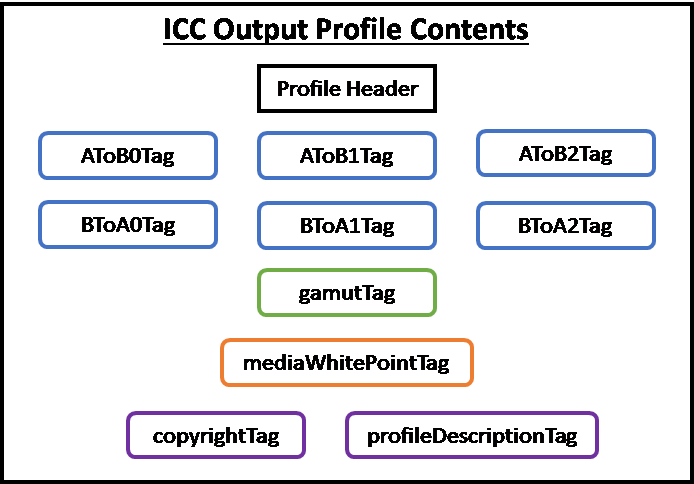
FIGURE 5. OVERVIEW OF CONTENTS OF A CMYK OUTPUT PRINTER ICC PROFILE
Initially there were three basic types of transform that could be encoded as tags in ICC profiles: Look-Up Table (LUT) based, Matrix/Tone Reproduction Curve (TRC) based, and Named Color Table based. With Version 4.3 profiles, Multiple Processing Element (MPE) based transform tags were introduced, and MPE based transforms are more fully utilized and extended in iccMAX profiles.