

Making connections with iccMAX
iccMAX profile connection Background and basics Decisions and capabilities
Next: Connecting with iccMAX
Decisions and capabilities
Decision-making is a shared responsibility between an Application making use of colour management, the Colour Management Module (CMM) and the colour Profile(s). There was considerable debate in the early days of the ICC related to the role of decision making by the CMM. There were two groups of opinion.

FIGURE 6. WHERE ARE THE COLOUR MANAGEMENT DECISIONS PERFORMED?
In the first group, few decisions are made by the profile maker in creating the profile resulting in “dumb” profiles that only provide measurement data and most decisions are made by a “smart” CMM about how colour management should be accomplished involving things like (but not limited to): device modelling, colour rendering, gamut mapping, and colour channel (ink) separation.
In the second group, most decisions are made by the profile maker in creating the profile resulting in “smart” profiles that have the same aspects of colour management encoded within transforms in the profile which are then applied by a “dumb” CMM that only knows how to apply the transforms. Variability can be encoded as separate transforms that the Application could select from.
The choice between these approaches was tempered by the desire to create an open, vendor-neutral platform that would provide interoperability, predictability, and consistency. The first approach provides much greater flexibility, but it is much more difficult to achieve these objectives as many of the decisions to be made are generally solved using proprietary solutions and standardizing a smart “CMM” quickly becomes untenable.
Thus, the second approach was taken, various limitations were accepted, and any operations performed by the CMM (like PCS processing) were spelled out by the specification to ensure interoperability, predictability, and consistency. This has proved to be a very successful approach in most workflows (particularly with ICC-based colour management implementations used in the graphic arts).
However, various limitations of the approach adopted in V2/V4 profiles have prevented (or made impractical) the use of ICC-based colour management in scenarios where more complex communication about colour, colour appearance, and transform expression are needed or desired.
An endeavour was undertaken within the ICC (over the course of a decade) to address limitations and new requirements that were identified by groups interested in (but unable to use) ICC-based colour management. These efforts resulted in the iccMAX specification.
It is critically important to note that though limitations have been overcome and capabilities have increased with iccMAX, the fundamental approach of having limited CMM decision-making has remained for the same reasons as for V2/V4 profiles. Thus, more information is required in iccMAX profiles and more selections are presented to or by calling applications. This results in removing limitations, increasing capabilities, and providing support for more colour management scenarios using an open, vendor-neutral platform that provides interoperability, predictability, and consistency.
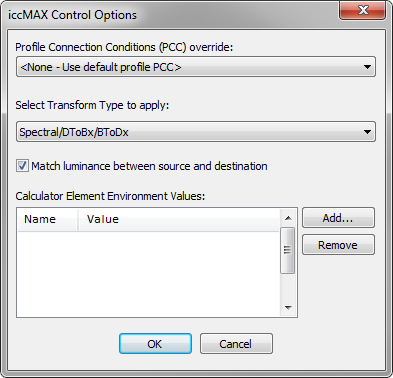
FIGURE 7. EXAMPLE APPLICATION ICCMAX CONTROL OPTIONS DIALOG
Additional selection information needed for a calling application to an iccMAX-enabled CMM for iccMAX profile handling may include: transform type selection, profile connection conditions override, luminance matching flag, and calculator element environment values.
Next: Connecting with iccMAX